
Honda and ODOT Test AI System for Real-Time Road Monitoring
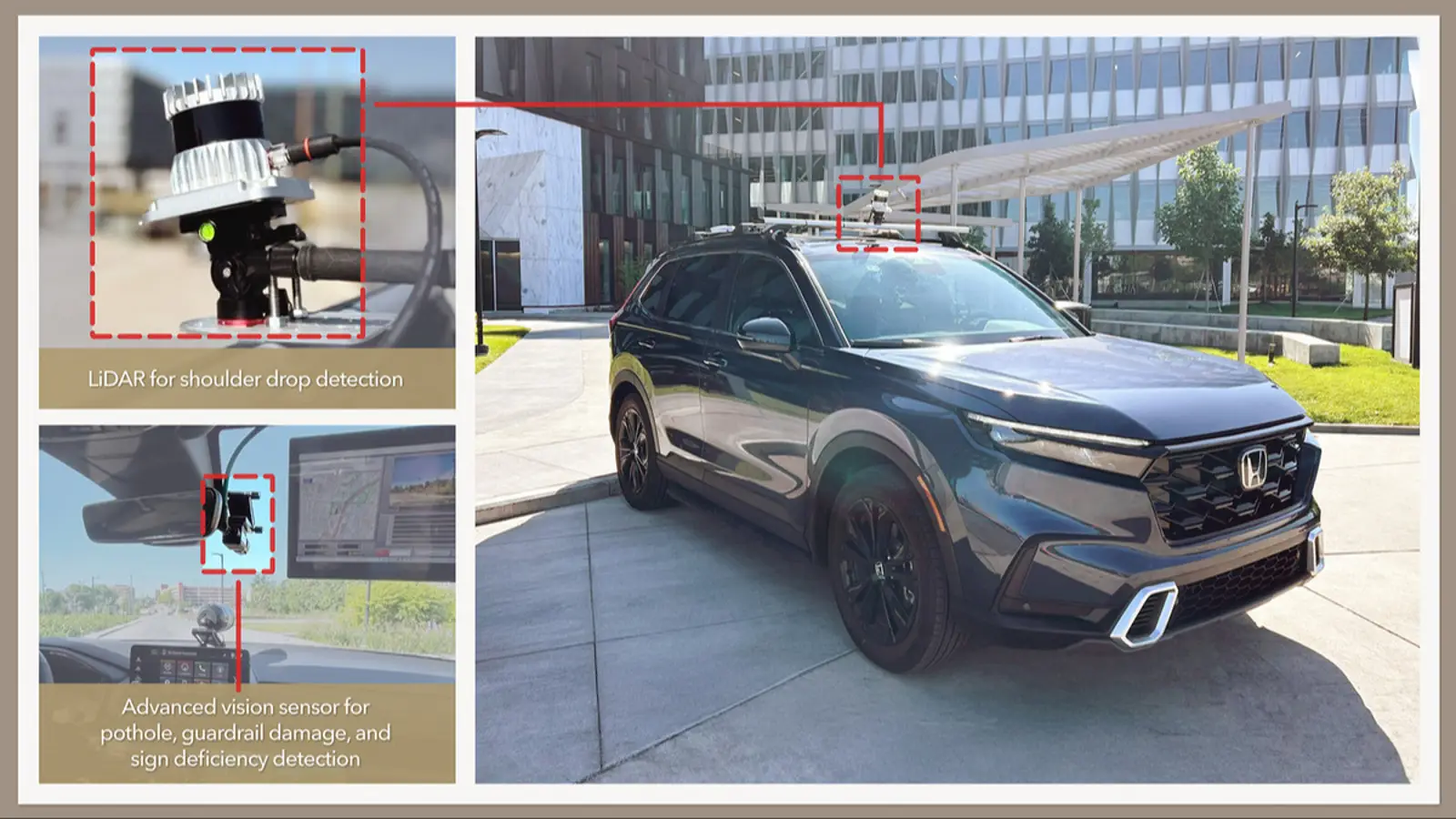
Honda and ODOT pilot AI-powered road monitoring using vehicle sensors to detect potholes and hazards in real time. Learn how it may improve safety and reduce costs.
A system capable of detecting potholes and damaged guardrails with up to 93% accuracy has already been tested across thousands of miles of roads — and could save millions of dollars annually. This was demonstrated by a pilot project led by Honda and the Ohio Department of Transportation (ODOT), where vehicles effectively became continuous monitoring tools for road infrastructure.
The concept is built on using sensors that already exist in modern vehicles. Cameras and LiDAR, typically used for driver assistance systems, were repurposed to capture road conditions and roadside assets during normal driving. The collected data was processed using artificial intelligence and transmitted to a cloud-based platform, where repair tasks were automatically generated and prioritized. As a result, road crews no longer needed to drive around searching for issues — the system identified them and ranked their urgency.
The pilot covered approximately 3,000 miles of roads in central and southeastern Ohio. The system detected potholes, damaged guardrails, missing or degraded road signs, pavement issues, and other hazards. Accuracy reached 93% for guardrails and 89% for potholes, with road sign detection reaching up to 99%. This not only accelerated repairs but also improved their precision, ensuring that the most critical safety issues were addressed first.
The significance of the project becomes clearer when considering the scale of the infrastructure. ODOT maintains more than 43,000 lane miles of roads and one of the largest interstate networks in the United States. In such an environment, traditional inspection methods require substantial resources, while automated monitoring offers a fundamentally different approach to maintenance.
The financial impact is equally notable. Project estimates suggest that large-scale deployment could save more than $4.5 million per year, primarily by reducing manual inspections and enabling more efficient planning. Repairs can be performed earlier, before issues escalate into more costly problems.
Safety is another critical factor. Road inspections are often carried out in hazardous conditions, including narrow roads and areas with heavy traffic. By automating defect detection, the system reduces the need for manual inspections and helps lower risks for roadside workers.
The project has been under development since 2021 and brought together multiple partners, including Parsons, i-Probe, and the University of Cincinnati. Their collaboration created a system where data collection, analysis, and infrastructure management are connected in a single workflow.
Looking ahead, Honda is already in discussions with several states to expand the system beyond Ohio. A future step could involve broader participation, where everyday vehicles contribute data during regular driving. Participation would remain voluntary, and the data collected is limited to essential elements such as location and detected road issues.
If adopted at scale, this model could transform roads into a continuously monitored system — one that relies on the vehicles already using it every day.
Mark Havelin
2026, Apr 15 21:04