
Inside the Bugatti Tourbillon: Interior Design and Philosophy
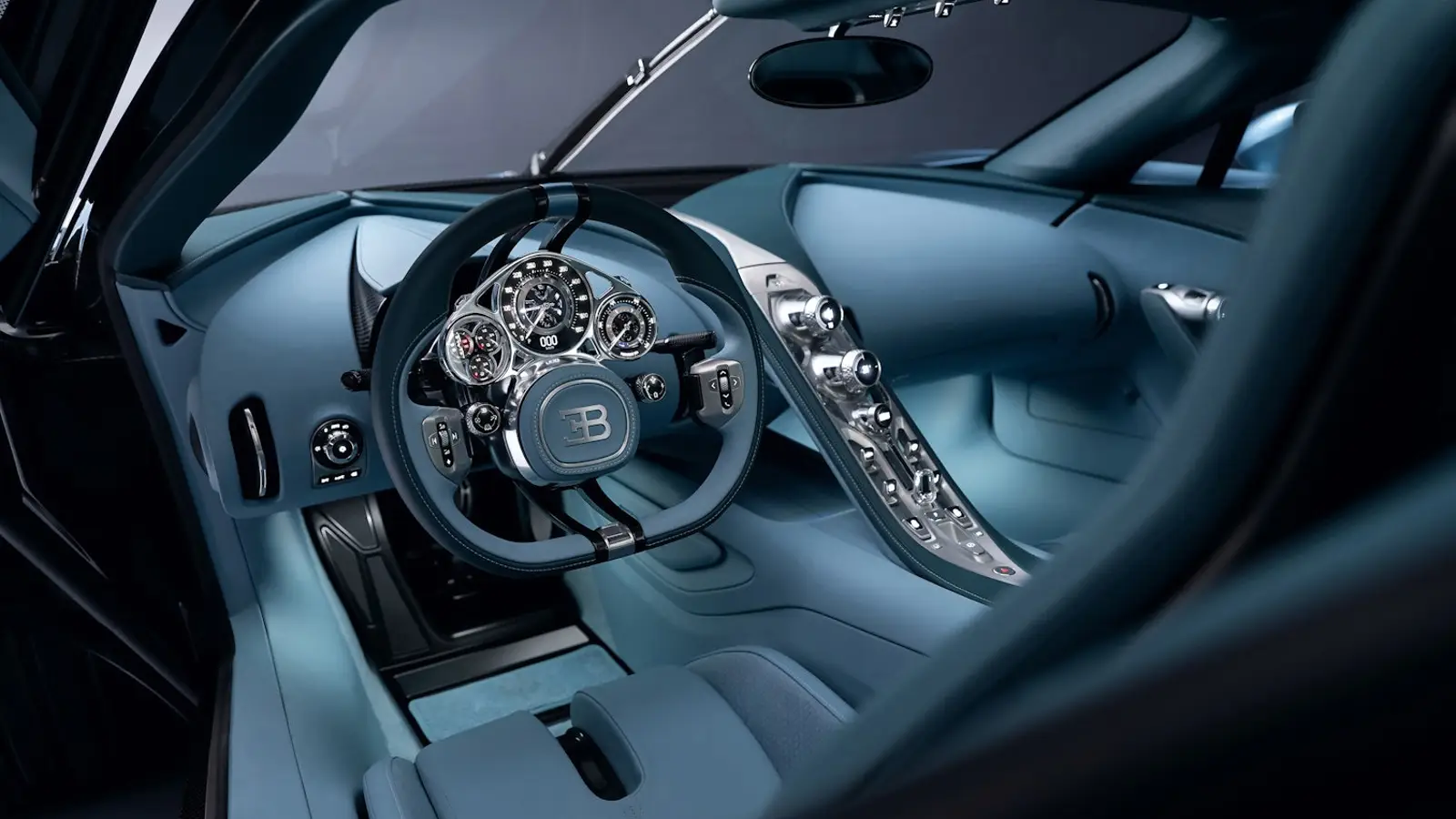
Bugatti reveals the interior concept of the Tourbillon, explaining its analogue philosophy, materials, and design choices, as presented by the brand’s designers.
The interior of the Bugatti Tourbillon has been conceived as a response to one of the brand’s most fundamental challenges: creating a space that resists visual and conceptual aging. In the new hypercar, this ambition is expressed through a deliberate rejection of short-lived trends in favor of a timeless aesthetic rooted in heritage and the philosophy of fine watchmaking.
The cabin was developed under the direction of Bugatti’s Chief Interior Designer, Ignacio Martinez, whose role spans from the earliest sketches to production readiness. His approach goes beyond visual identity, focusing equally on a clear and intuitive user sequence. In the Tourbillon, the interior mirrors the exterior: the iconic central line and Bugatti’s signature C-line are reinterpreted inside the cabin, subtly dividing the space into distinct driver and passenger zones.
Materials play a defining role in shaping the atmosphere. Bugatti has expanded its interior palette, combining supple leather with newly developed fabrics for the seats and door panels. The brand refers to this philosophy as “car couture” — a translation of haute couture principles into the automotive world. The objective is not decoration for its own sake, but a tactile and visual experience designed to remain relevant for decades.
Creative ambition, however, was closely balanced with engineering reality. The interior had to accommodate airbags, seatbelt positioning, and crash behavior, all while preserving the original design intent. As the Tourbillon is a road-going vehicle, safety, comfort, and regulatory compliance were integral constraints throughout the development process.
At the core of the cabin lies the concept of timelessness, a theme directly linked to the model’s name. The Tourbillon takes inspiration from the early 19th-century horological invention created to counteract gravity’s effect on accuracy. In a similar spirit, Bugatti’s designers sought to avoid digital fashions, instead creating an interior meant to endure and be passed down through generations.
This philosophy led to a consciously analogue human-machine interface. Digital elements are reduced to the essentials, while physical controls take precedence, engineered for precise haptic feedback and mechanical resistance. The central display remains hidden within the dashboard, deploying only when required, preserving the visual purity of the cabin.
The driver’s attention is drawn to the steering wheel and instrument cluster, which form the centerpiece of the driving experience. A fixed-hub steering wheel ensures constant visibility of the instruments, while the fully analogue cluster is a mechanical achievement developed in collaboration with Swiss watchmakers. Comprising more than 600 components and housed in titanium, the assembly reflects the precision, craftsmanship, and skeletonized beauty associated with traditional horology.
Through this approach, the Tourbillon’s interior becomes more than a functional environment. It stands as a statement about the future of luxury, where engineering, craftsmanship, and design converge to create an experience defined not by novelty, but by lasting value.
Mark Havelin
2025, Dec 20 04:07