
Crash Testing Supercars: Methods, Costs, and Missing Ratings
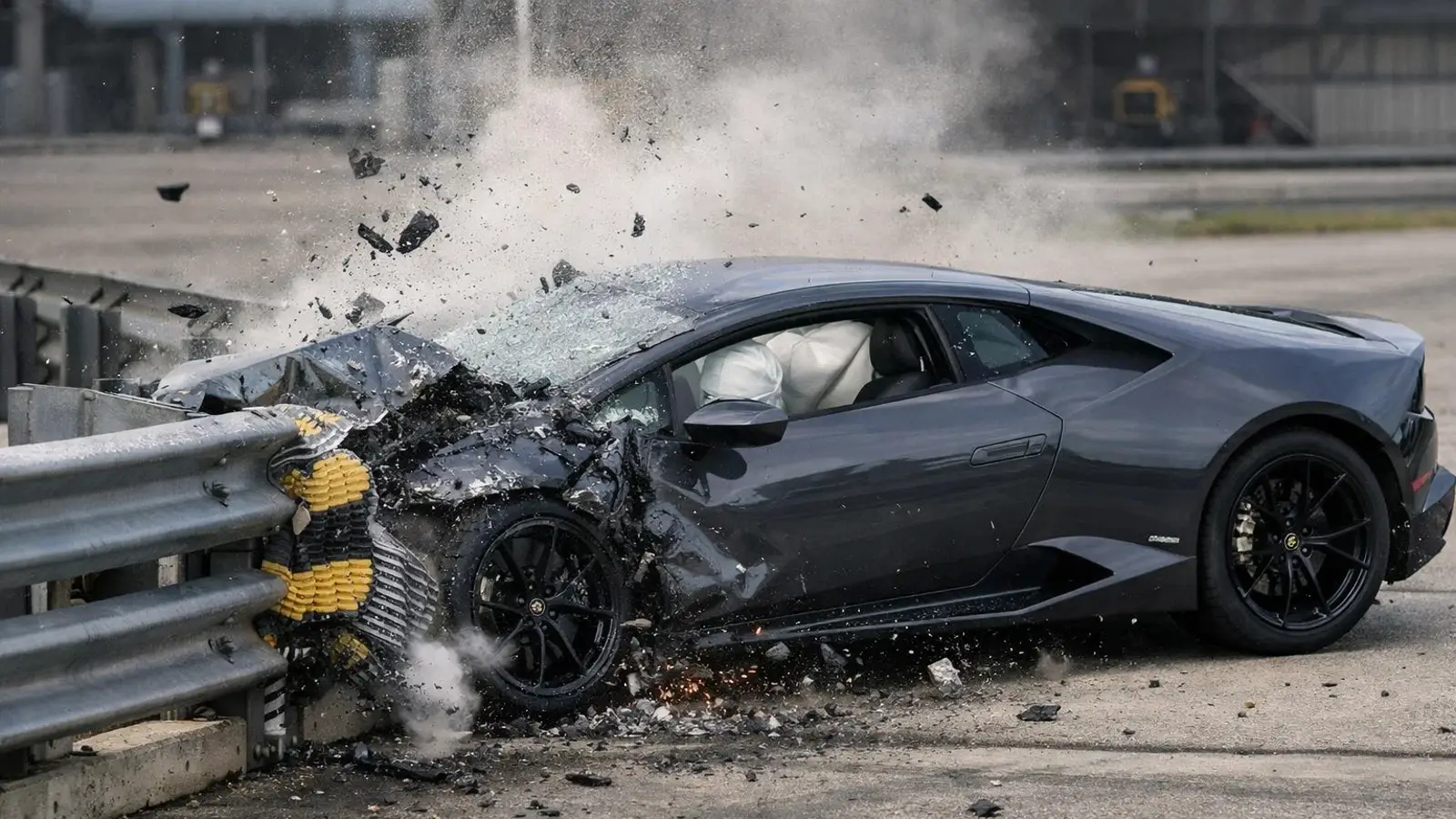
An in-depth look at how supercars and hypercars are crash tested, who pays for these tests, and why brands like Ferrari or Koenigsegg often lack public ratings.
The topic of crash testing in the supercar and hypercar segment inevitably raises questions. Are cars costing millions of dollars tested in the same way as mass-market vehicles, and if not, why are the results so rarely made public? Behind this apparent opacity lies not a rejection of safety, but a different logic for proving it.
First of all, there is no single universal “mandatory crash test” in the familiar sense. In the United States, the system is based on self-certification: manufacturers declare compliance with federal safety standards themselves, while the regulator, the NHTSA, does not approve vehicles before they go on sale. Oversight takes place after market entry through spot testing, investigations, and recalls. Alongside this, the government-run NCAP program publishes five-star safety ratings, but participation is not mandatory.
An independent perspective on safety is provided by the IIHS, an institute funded by the insurance industry. Its crash tests and ratings are designed primarily to reduce insurance risk. Even so, manufacturers—especially those producing niche or low-volume vehicles—are not required to participate.
Europe is even more explicit. Euro NCAP states clearly that its program is voluntary. All costs related to testing, assessment, and publication are borne by the party nominating the vehicle. In some cases, costs are shared, but the principle remains the same: the absence of a rating reflects non-participation, not the absence of engineering validation.
This is where the reality of supercars and hypercars comes into focus. For manufacturers producing extremely small volumes, destroying even a single vehicle represents a significant economic loss. As a result, many rely on a layered approach: extensive computer simulations, followed by material and component testing, and only then physical tests of the complete vehicle. Rimac has publicly described this process, emphasizing the need to correlate virtual models with real-world physical loads.
Some brands go further still. Koenigsegg has openly explained that traditional crash-testing models are not always suitable for ultra-low production volumes. The company emphasizes engineering calculations and testing methodologies that allow a single vehicle to be subjected to repeated loads, reducing the need to fully destroy multiple cars. Koenigsegg models do not carry published Euro NCAP or NHTSA NCAP ratings, a direct consequence of the voluntary nature of these programs.
Ferrari, Lamborghini, and McLaren operate on a different scale, but the underlying logic is similar. Their cars must meet regulatory safety requirements in all markets where they are sold, including the U.S. self-certification system. However, most road models from these brands also lack published Euro NCAP ratings. For manufacturers focused on performance-driven, limited-volume vehicles, participation in star-based rating systems is not a core element of brand communication.
No verified list of manufacturers that “do not conduct crash tests at all” has emerged . What can be stated with confidence is that some brands do not publish results within independent rating programs. This distinction matters: the absence of public stars is not evidence of absent testing.
As transparency expectations grow and insurers and regulators continue to increase their influence, even the ultra-expensive segment is likely to face more scrutiny. Yet if current practice is any indication, the way safety is demonstrated will remain fundamentally different from that of the mass market.
Allen Garwin
2026, Jan 02 01:55