
How Toyota’s IsoDynamic Performance Seat works in the Tacoma TRD Pro
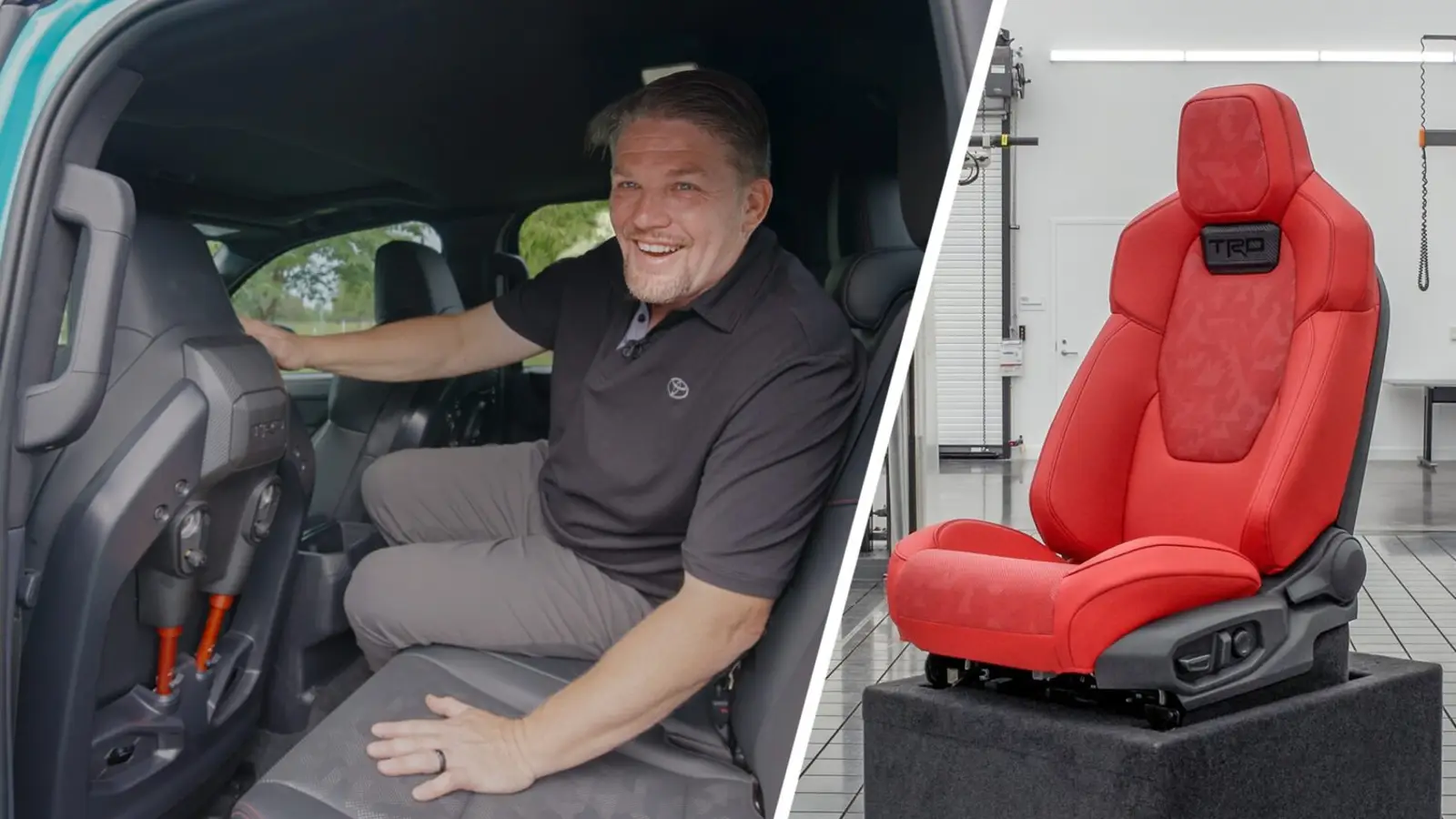
Learn how Toyota’s IsoDynamic Performance Seat works in the Tacoma TRD Pro, with insights from its development team and guidance on proper use.
A few years ago, Toyota drew significant attention in the off-road pickup segment with the introduction of the IsoDynamic Performance Seat in the Tacoma TRD Pro. Unlike conventional solutions, this seat immediately stood out thanks to its built-in suspension system, designed to reduce physical impact on the driver and front passenger when traveling over rough terrain.
The core idea behind the IsoDynamic Performance Seat is that impact mitigation does not rely solely on the vehicle’s suspension, but also occurs directly at the point where the driver interacts with the vehicle. The seat features an air-over-oil shock absorber system that allows it to move both vertically and laterally at the same time. This multi-directional movement helps limit abrupt body motion, stabilize the head and neck, and maintain more natural spinal alignment during demanding off-road driving.
Toyota notes, however, that the system is not entirely intuitive. The IsoDynamic Performance Seat comes with a learning curve and requires proper setup to work as intended. To address this, Toyota released a dedicated explanation featuring Todd Muck, an executive engineer in Product Development at Toyota Motor North America Research & Development, who played a key role in creating the seat and explains how to adjust and use it effectively.
A key part of the design is its adjustability. The damping characteristics can be tuned to suit the occupant’s weight and preferences, and the system can also be bypassed when needed. This flexibility highlights that the IsoDynamic Performance Seat was conceived not as a one-size-fits-all solution, but as a configurable tool for different driving styles and terrain conditions.
In real-world use, the unconventional construction has sparked mixed reactions. While the seat clearly sets itself apart from traditional automotive seating and introduces a new approach to off-road comfort, its mechanical complexity affects cabin packaging and requires adaptation from the driver. For that reason, Toyota places emphasis not only on the technology itself, but also on understanding how to use it properly.
The IsoDynamic Performance Seat reflects Toyota’s broader willingness to experiment with unconventional engineering, shifting attention from individual vehicle components toward the comfort and stability of the person behind the wheel. Whether such systems will become a broader trend in off-road vehicles will largely depend on how drivers respond to this balance between innovation and everyday usability.
Mark Havelin
2026, Jan 18 22:15