
Bentley and FAT International Begin Partnership at Ice Race
Reported by Bentley, it begins a multi-year partnership with FAT International at the Ice Race, debuting models and the Bentayga X Concept. Learn more.
Hyundai Motor Company and Kia Corporation have announced the development of Vision Pulse, a driver safety technology designed to detect objects around a vehicle even in situations where visibility is limited. The system is based on ultra-wideband (UWB) signals, enabling precise real-time positioning.
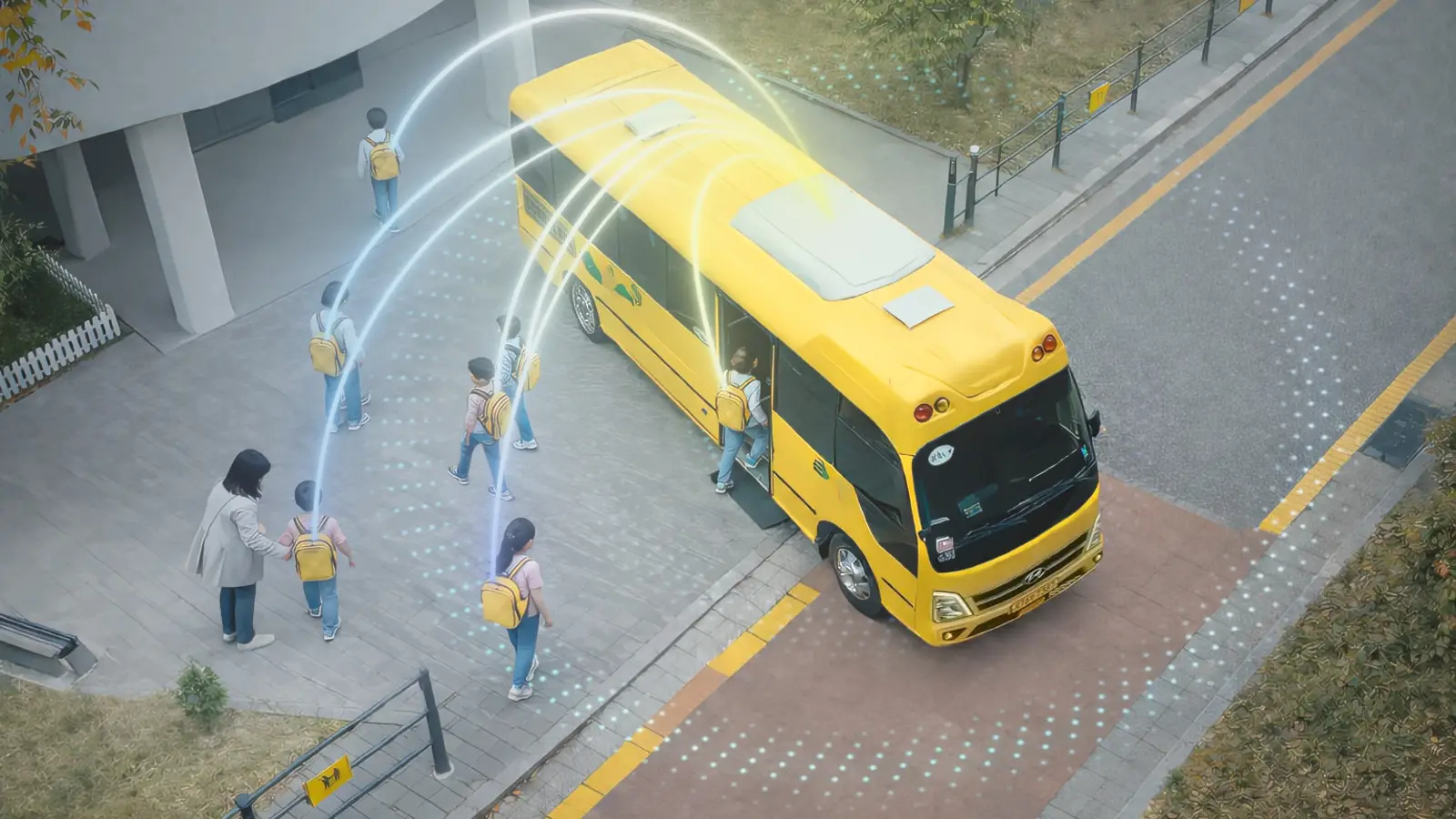
Vision Pulse operates through UWB modules installed in the vehicle, which exchange signals with nearby UWB-equipped objects. These may include other vehicles, bicycles, smartphones, wearables, or tracking devices. By measuring the signal travel time, the system calculates exact object positions and issues alerts when a potential collision risk is identified.
According to the companies, the technology can detect objects with accuracy of up to 10 centimeters within a radius of 100 meters, even in complex urban environments with visual obstructions such as intersections or densely built areas. Communication latency is stated to be between 1 and 5 milliseconds, supporting real-time safety applications. Detection accuracy is reported to exceed 99 percent, including during nighttime or adverse weather conditions.
A key aspect of Vision Pulse is its potential to reduce reliance on costly sensors such as LiDAR and radar. Hyundai and Kia note that vehicles equipped with their Digital Key 2 system already contain UWB modules, which may allow the technology to be deployed without additional hardware.
To enhance real-world usability, the companies have developed predictive algorithms capable of tracking multiple fast-moving objects around a vehicle simultaneously. This approach expands the possible use cases of Vision Pulse beyond passenger cars.
Hyundai and Kia are already testing the technology in industrial environments. Since 2025, trials have been conducted at the Kia PBV Conversion Center in Hwaseong, South Korea, where Vision Pulse is used to help prevent collisions between forklifts and workers. Additional pilot programs are planned with the Busan Port Authority following an agreement signed in October 2025.
The companies also see potential applications beyond driving assistance, including industrial mobility and disaster response scenarios such as locating individuals trapped under debris. These use cases are currently presented as future possibilities.
Alongside the announcement, Hyundai and Kia released a campaign video titled “Sight Beyond Seeing: The Technology That Sees the Unseen.” The video demonstrates Vision Pulse on school buses and introduces UWB-enabled protective keyrings designed for children, which can be attached to backpacks and also function as nightlights to encourage regular charging.
Hyundai and Kia emphasize that Vision Pulse remains an advanced pre-development technology, and its potential application in mass-production vehicles is still under consideration.
Mark Havelin
2026, Feb 03 12:36