
Crash Test History: The Evolution of NCAP, IIHS and Euro NCAP
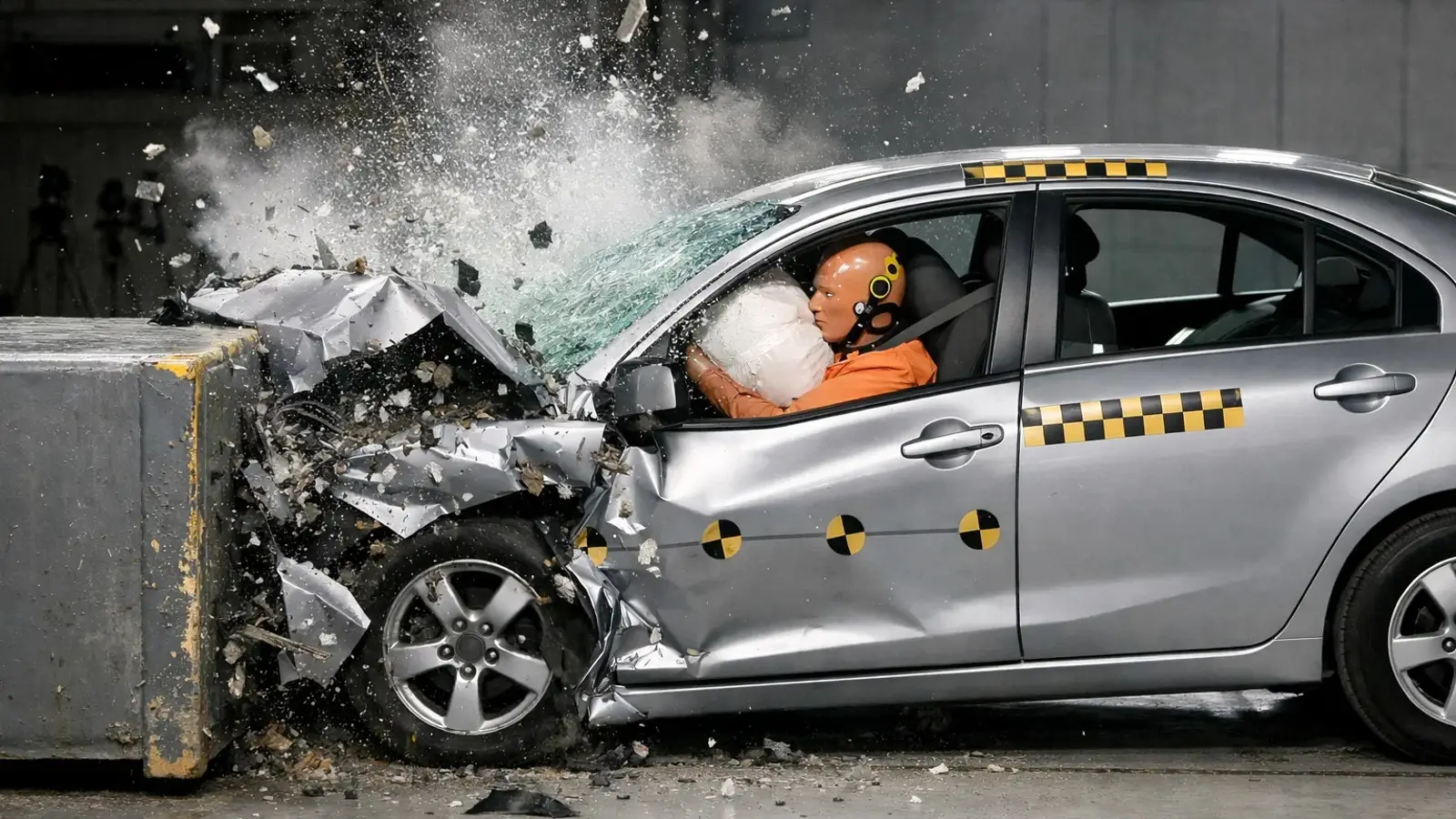
Explore the history of crash tests, from early barrier impacts to NCAP and IIHS ratings, and see how modern safety standards continue to evolve.
Crash tests have long stopped being just dramatic footage of a car slamming into a concrete wall. Today they represent a broad system of engineering assessments and public safety ratings that directly influence how vehicle bodies are designed, how seat belts and airbags are calibrated, and which electronic assistance systems become standard in new models.
The history of crash testing began well before the era of familiar safety “stars.” One of the earliest documented examples comes from General Motors, which conducted a barrier impact test as far back as 1934. At the time, the method was strikingly different from modern standards: a driver accelerated the vehicle toward a barrier at a speed that still allowed him to leave the car just before impact. Even though the approach seems extreme today, it marked an early attempt to treat collisions not as random misfortune, but as a phenomenon that could be studied and managed.
By the mid-20th century, crash testing became more structured. Publications from the Transportation Research Board describe a barrier test involving a 1955 Ford Tudor, where passenger dummies were used and the crash itself was analyzed as a tool for understanding impact physics and vehicle structural behavior. Gradually, it became clear that safety was not only about strong metal, but about how crash energy travels through the cabin and affects occupants.
A major turning point came when crash tests evolved into a public benchmark for consumers. In the United States, the National Highway Traffic Safety Administration (NHTSA) established the New Car Assessment Program (NCAP) in 1978, with frontal barrier testing beginning in 1979. Over time, the protocol expanded: side impact barrier testing was introduced in 1996, rollover assessments were added in 2000 and 2003, and side pole testing followed in 2011.
In the early 2010s, attention began shifting beyond crash survival to crash prevention. NHTSA documentation notes that assessments of driver assistance technologies were introduced starting with model year 2011 vehicles. Today, NCAP covers both crashworthiness and crash avoidance performance, reflecting a broader understanding of what “vehicle safety” means.
Alongside government testing, an independent force emerged in the US. The Insurance Institute for Highway Safety (IIHS) began issuing crash test ratings in 1995, launching its work with the moderate overlap front test. This type of crash scenario became important because it challenged vehicle structures in a different way than full-width frontal tests, highlighting how a partial overlap can place extreme stress on the front end and cabin integrity.
Europe followed its own path through Euro NCAP, which was officially launched in 1997. Over time, its safety ratings became a major reference point for manufacturers selling into the European market.
Germany, in particular, developed a strong crash testing infrastructure. The ADAC reports that its technical center in Landsberg has conducted around 1,700 crash tests since 1997, with roughly 70 new tests carried out each year. Its work extends beyond vehicles themselves, covering safety accessories, passenger restraint systems, and cargo securing methods.
Another key player is DEKRA, whose crash testing serves not only consumer safety evaluations but also accident reconstruction. The company explains that its Crash Test Center is frequently used in investigations requested by courts and insurers, and that manufacturers increasingly rely on the facility for complex cases involving product safety liability.
German public institutions also contributed to the long-term development of crash research. TRID/TRB documentation notes that the first crash tests at a new facility operated by BASt were conducted in May 1979, marking the start of systematic testing efforts that continued over the following decades.
Crash testing continues to evolve today, reflecting new expectations and emerging safety challenges. One of the most visible shifts is the push toward more realistic representation of different types of occupants. In 2025, the Associated Press reported that the US Department of Transportation introduced a new crash test dummy model designed around female anatomy, known as THOR-05F. The move highlighted how testing methods are gradually being refined to better match real-world injury risks.
Against this backdrop, the continued expansion of programs like NCAP is no longer just about ratings. It is increasingly a sign of where the entire safety philosophy is heading. As protocols become more demanding and timelines for new requirements are set for future model years, the industry’s focus appears to be shifting from simply surviving an impact toward making serious crashes less likely in the first place.
Allen Garwin
2026, Feb 15 19:59