
MAN Demonstrates Megawatt Charging for eTGX in Swedish Winter
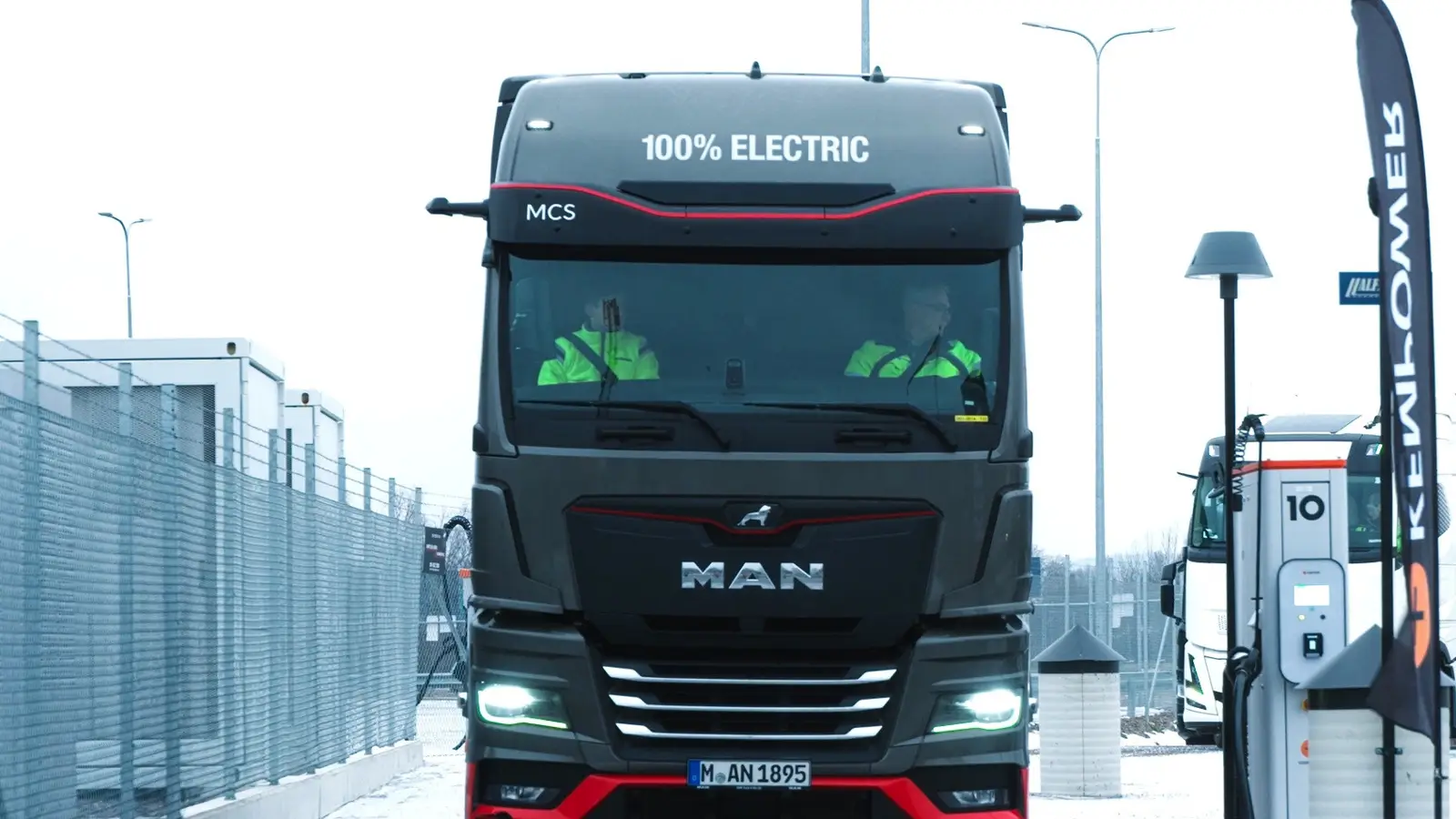
MAN showcased 750 kW megawatt charging for the eTGX at Kempower’s Winter Days in Sweden, highlighting MCS interoperability and winter performance.
MAN Truck & Bus has taken megawatt charging out of the laboratory and into a Scandinavian winter. At the Kempower MCS Live Winter Days 2026 in Norrköping, the company publicly demonstrated how its electric MAN eTGX can charge using the Megawatt Charging System (MCS) under sub-zero conditions.
The showcase took place at the premises of Swedish transport operator Alfredsson’s, a Kempower customer. The focus was not only on peak power but on process stability in cold weather and under real operational loads. According to MAN, the eTGX charged publicly at around 750 kW, while megawatt charging makes it possible to replenish the battery from 10% to 90% in approximately 30 minutes.
MAN emphasised that the core objective was to validate technical interoperability between vehicle and charging infrastructure. As the industry moves toward large-scale deployment, compatibility between trucks and high-power chargers becomes decisive. The event brought together representatives from vehicle manufacturers, infrastructure providers and industry associations, underlining the broader ecosystem behind megawatt charging.
The Alfredsson’s depot itself illustrates how such infrastructure can be implemented. The site operates with a 2.4 MW grid connection, supported by a battery energy storage system reported at 2.2–2.4 MWh and a 400 kW solar installation. This configuration enables flexible load management and supports high-power charging for heavy-duty vehicles.
The demonstration was not limited to prototypes. The MAN eTGX and MAN eTGS can already be ordered with the MCS option, and series production of this configuration is scheduled to begin in the second quarter of 2026. This signals a transition from pilot projects to industrial readiness.
At the European level, regulatory requirements for heavy-duty charging infrastructure foresee a gradual rollout of high-power charging hubs along key transport corridors. In that context, megawatt charging is emerging not merely as a technical milestone but as a central component of future freight logistics.
The winter test in Sweden suggests that megawatt charging is moving beyond theory and toward practical application in long-haul transport. The next challenge will be scaling — and the pace of that expansion will depend largely on seamless interoperability between vehicles and infrastructure.
Mark Havelin
2026, Feb 17 06:43