
Mercedes-Benz at Retro Classics 2026: 140 Years of Innovation
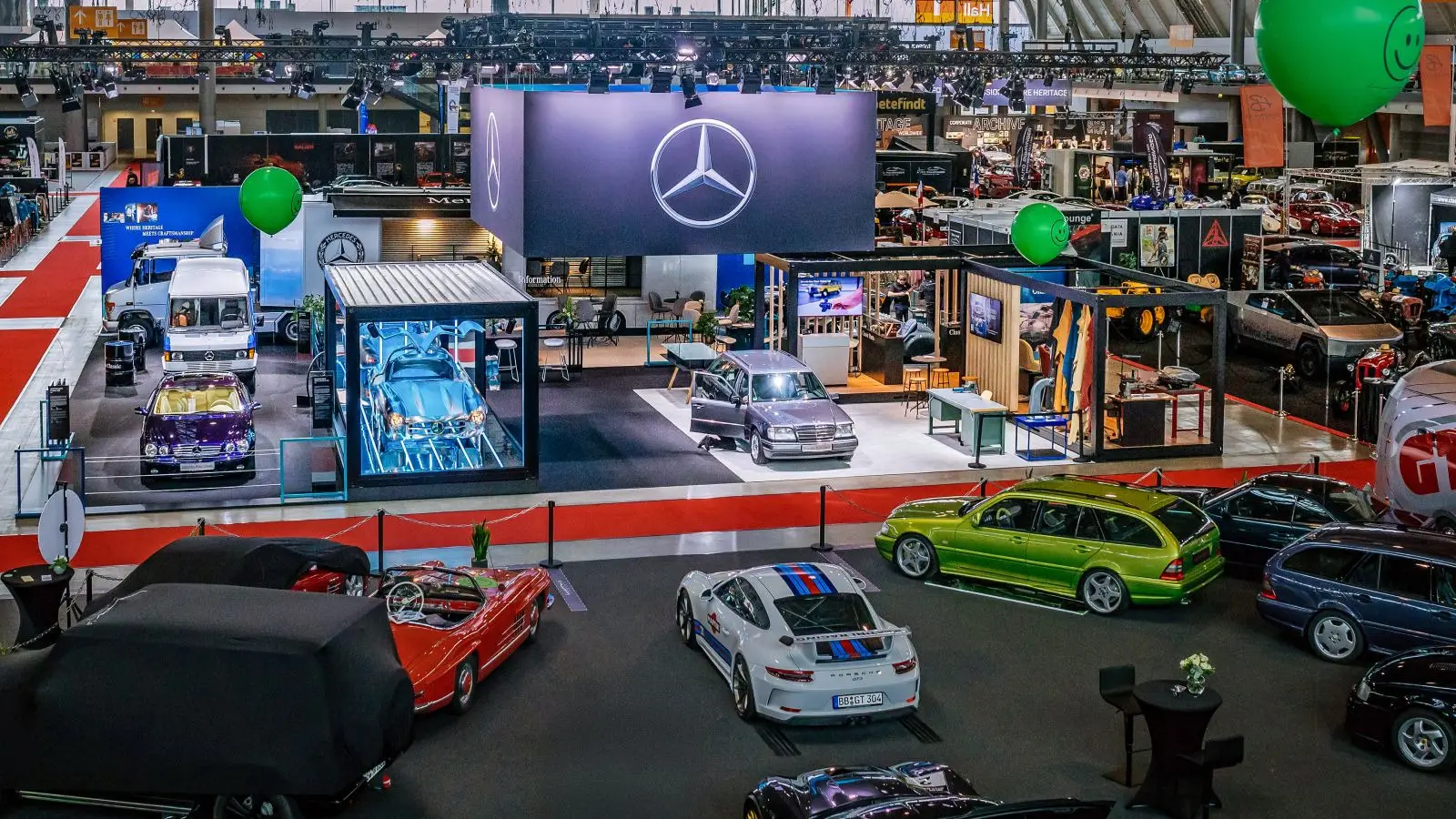
Mercedes-Benz Heritage marks 140 years of innovation at Retro Classics 2026 in Stuttgart, highlighting Classic Center expansion, SL models and new genuine parts.
In February 2026, Stuttgart once again becomes a focal point for automotive history. At Retro Classics, held from 19 to 22 February and marking its 25th anniversary, Mercedes-Benz turns the spotlight on more than nostalgia, framing the exhibition around the 140th anniversary of Carl Benz’s 1886 patent, widely regarded as the birth certificate of the automobile.
The anniversary is not treated as a symbolic milestone but as a structural theme. In Hall 1, Mercedes-Benz Heritage presents the results of its reorganisation, placing the expanded Mercedes-Benz Classic Center in Fellbach at the centre of attention. Opened in 1993, the facility is now undergoing its most significant upgrade yet: workshop capacity has nearly doubled, workstations have been modernised, and by early summer 2026 the site is set to become the world’s largest dedicated restoration and service centre for Mercedes-Benz vehicles.
The Classic Center consolidates expertise across all eras, from pre-war automobiles to young classics and rare racing machines. It also services vehicles from predecessor brands as well as SLR McLaren and Maybach models. By concentrating restoration disciplines under one roof, the centre aims to deliver factory-level authenticity and technical precision.
At Retro Classics, this expertise translates into tangible highlights. Three SL models illustrate different decades of the brand’s sporting lineage. The most striking is a 1960 300 SL Roadster (W 198) presented as a “barn find” and shown in Germany for the first time after being discovered in Pennsylvania. The 300 SL remains one of the most iconic Mercedes-Benz models ever built: a production car equipped with mechanical direct fuel injection and capable of reaching around 260 km/h, symbolising the technological ambition of the 1950s.
Alongside it stands a 230 SL “Pagoda” (W 113), produced between 1963 and 1971 and named after the distinctive shape of its hardtop roof. The model is associated with the evolution of Mercedes-Benz inline six-cylinder engines such as the M127, M129 and M130. Completing the trio is a 300 SL from the R107 series, one of the commercially most successful interpretations of the SL line, produced through the 1970s and 1980s.
Original parts supply forms another key pillar of the presentation. The Mercedes-Benz Classic Genuine Parts programme currently comprises around 160,000 items. For 2026, particular attention is given to the reproduction of an oil pump for the M108, M114, M129 and M130 engines used in various 1960s model series. As original pumps are generally beyond repair, accurate remanufacturing based on factory documentation becomes essential for preserving authenticity.
A world premiere is marked by newly reproduced steering wheels, including versions for the Mercedes-Benz 600 (W100). Produced from 1963 to 1981, the 600 became known for its complex hydraulic comfort system controlling windows, seats and other features. The new steering wheels replicate the original cellulose acetate butyrate material and were tested in cooperation with TÜV Rheinland to meet strict safety standards.
The historical dimension is reinforced by the presence of an original 300 SLR (W 196 S) from the company’s collection. The model is inseparable from Mercedes-Benz’s dominance in the mid-1950s, most notably at the 1955 Mille Miglia. Stirling Moss and Denis Jenkinson completed the 992-mile race in 10 hours, 7 minutes and 48 seconds at an average speed of about 158 km/h. In the same event, John Fitch finished fifth overall and won the GT class in a 300 SL. The exhibition also commemorates Hans Herrmann, who passed away in January 2026 and was one of the drivers associated with the Silver Arrows era.
The anniversary extends beyond the exhibition halls. As part of the “140 Years. 140 Places” initiative, three new S-Class saloons have embarked on a transcontinental journey of more than 50,000 kilometres across six continents, scheduled to conclude in Stuttgart in October 2026. It is a symbolic choice: officially designated as S-Class since 1972 with the W116 generation, the model introduced innovations such as ABS in 1978 and has long served as a technological flagship.
From patent number 37435 filed by Carl Benz to today’s global flagship tours, Mercedes-Benz presents its heritage not as an archive, but as a framework for continuity. At Retro Classics 2026, the past is carefully curated—yet clearly positioned as a foundation for the future.
Mark Havelin
2026, Feb 17 08:33