
Hyundai Motor Group Donates Unmanned Firefighting Robots to Korea National Fire Agency
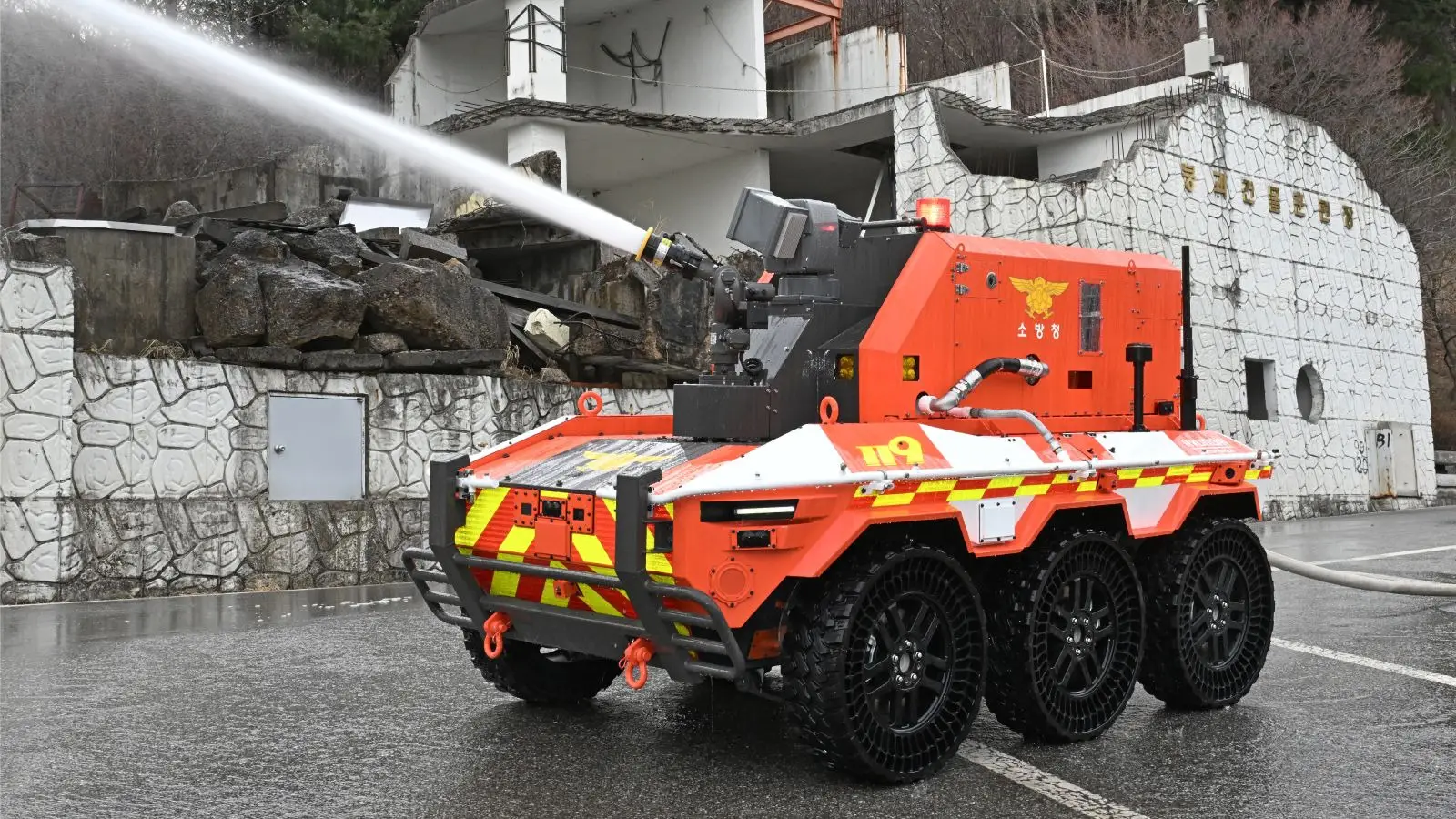
Hyundai Motor Group donates four unmanned firefighting robots to the Korea National Fire Agency, supporting safer emergency response. Learn more.
Hyundai Motor Group has strengthened its cooperation with the Korea National Fire Agency by donating four unmanned firefighting robots designed for high-risk environments. The handover ceremony took place on February 24 at the National 119 Rescue Headquarters in Namyangju, Gyeonggi Province.
Among those attending were Executive Chair Euisun Chung, senior Hyundai Motor Group and Hyundai Rotem executives, and the Acting Commissioner of the Korea National Fire Agency. At the center of the event was new equipment intended to reshape how emergency teams respond in the most dangerous fire scenarios.
Developed jointly with the agency, the robot is based on Hyundai Rotem’s electrified multi-purpose HR-Sherpa platform. The six-wheel 6×6 unmanned vehicle with independent in-wheel motors was originally conceived as a modular system for tasks ranging from logistics to reconnaissance. In its firefighting configuration, it is equipped with a water cannon capable of direct and spray modes, a self-spraying cooling system, an infrared camera for visibility through smoke and flames, and full remote operation with real-time video transmission.
Thermal resilience is a defining feature. The robot can maintain an internal operating temperature of 50–60°C in environments reaching up to 800°C, enabling deployment in areas where human access would involve extreme risk. Industry publications describe the base HR-Sherpa platform as having an operational weight of around 1,800 kilograms, including payload, and a robust six-wheel configuration.
Two units have already been deployed to the Capital and Yeongnam 119 Special Rescue Units and are being used in live fire operations. Two additional robots will be delivered to the Gyeonggi Provincial Fire Headquarters in Hwaseong and the Chungnam Provincial Fire Headquarters. The systems are expected to support initial fire suppression in large-scale blazes, operate in areas at risk of structural collapse, and assess hazardous zones before firefighters enter.
According to figures cited in the release, 1,802 firefighters have been injured or killed in the line of duty over the past decade in South Korea. In that context, the shift toward remotely operated electric platforms reflects a broader strategy to reduce occupational risk. The electrified design also allows the robot to function in confined spaces filled with toxic combustion gases, where internal-combustion vehicles face operational limitations.
The initiative aligns with Hyundai Motor Group’s 2023 CSR mission, defined as “We make the right move towards free mobility, a safe society and a sustainable planet.” Support for firefighters forms part of that agenda. The Group has previously donated ten specially modified buses based on the Hyundai Universe Mobile Office to provide on-site rest and recovery facilities for fire crews.
Hyundai Motor Group has also pledged support for the country’s first National Fire Hospital, reported to be located in Chungbuk Innovation City. South Korean media describe the facility as a 302-bed institution built with an investment of approximately 207 billion won and operated by Seoul National University Hospital. The Group plans to donate vehicles and medical equipment to assist in treatment and rehabilitation.
Internationally, robotic firefighting systems have already been deployed in several countries, including the United States, France, and Germany, notably during the 2019 Notre-Dame fire. Against this backdrop, South Korea’s initiative signals a move to integrate advanced mobility technology directly into national emergency response infrastructure. Local business reports further indicate that the program may expand to as many as 100 units in the future.
Taken together, the donation represents more than a symbolic gesture. It suggests a gradual transition toward a response model in which robotic systems become the first line of entry in the most hazardous environments, allowing firefighters to operate as strategists and remote operators rather than front-line casualties.
Mark Havelin
2026, Feb 27 20:49