
Pop Art Car exhibition at Renault’s Paris carwalk
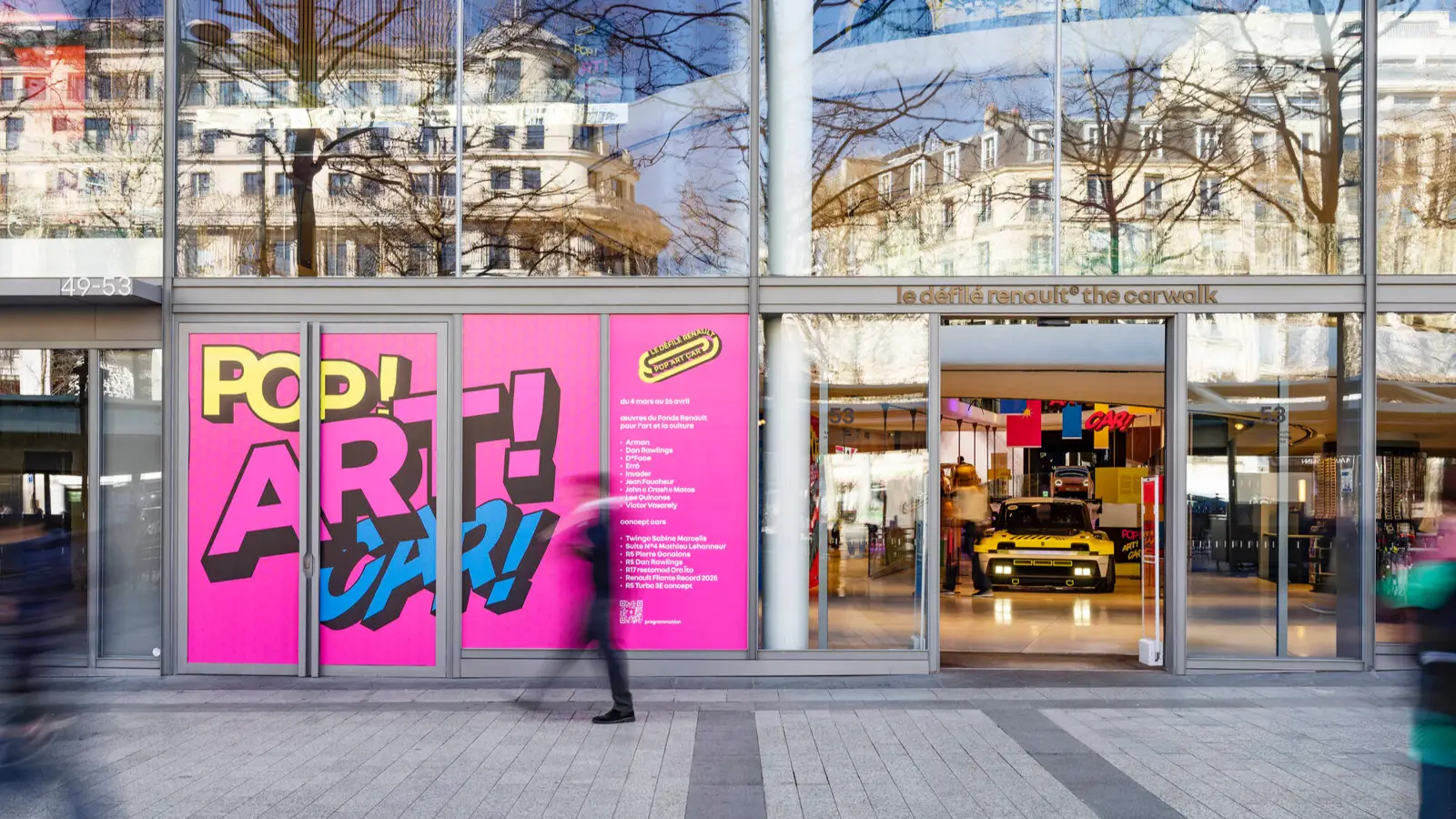
Renault presents the Pop Art Car exhibition in Paris, bringing together street art, pop art and iconic show cars at le défilé renault. Explore the artists and concept vehicles.
Running from March 4 to April 26, 2026 at le défilé renault® the carwalk on the Champs-Élysées, Pop Art Car is more than another brand-led cultural event. Created with the Fonds Renault pour l’Art et la Culture, the exhibition uses art, design and the automobile itself to retell part of Renault’s story through the language of popular culture.
The idea is straightforward, but layered. Pop Art turned everyday objects into artistic material, while Street Art later moved that conversation into public space, into the city and its fast, direct visual language. In that context, the car becomes more than a machine. It becomes a cultural sign — one tied to freedom, modernity, movement, design and changing social habits. That is the thread Renault follows throughout Pop Art Car, turning its Paris venue into a route through artworks, design statements and concept cars.
The exhibition brings together artists whose work connects in different ways to mass visual culture. They include Invader, whose imagery draws on video games and pixel-based aesthetics; Victor Vasarely, whose role matters to Renault not only as an artist but also because he redesigned the brand’s diamond logo in 1972; Erró, known for working with the codes of pop culture; Arman, who transformed industrial and serial objects into art; Jean Faucheur, linked to the French urban art scene; and D*Face and John “Crash” Matos, both associated with the international world of street and graffiti art. A particular highlight is Invader’s Pole Position from 2008, shown to the public here for the first time.
Yet Pop Art Car does not stop at paintings and urban art. Cars themselves are presented as design statements. Among them are Mathieu Lehanneur’s SUITE N°4, a reinterpretation of the Renault 4 conceived as an open-air hotel suite; Pierre Gonalons’ Renault 5 Diamant, which turns a familiar model into something close to a moving jewel; Sabine Marcelis’ Twingo, built around light, transparency and sculptural form; and the R17 electric restomod x Ora Ïto, a retro-futurist reading of the Renault 17. Dan Rawlings’ works Bourgeon and Accrescent add another angle, reshaping car metal into forms that seem almost organic.
One of the exhibition’s most significant pieces is Filante Record 2025. Renault presents it not only as a dramatic object, but as a laboratory for electric efficiency. Inspired by the company’s historic record cars, the demo car uses lightweight materials as well as steer-by-wire and brake-by-wire technologies, showing how closely design, engineering and energy efficiency are now linked. Renault says the vehicle covered 1,008 kilometres in less than ten hours in December, averaging 102 km/h while consuming 7.8 kWh per 100 kilometres. Within the wider exhibition, that gives the car another role: not just a symbol of culture, but a platform for technological experimentation.
In that sense, Pop Art Car also fits into a broader Renault strategy. The company points out that it has been working with artists since the 1960s, while the fund created in 2024 is intended to preserve, expand and open up that heritage to the public. Another step in that direction is taking shape in Flins, where Renault is developing new infrastructure around its history, artworks and archives. Seen from that angle, the current show on the Champs-Élysées feels less like a one-off event and more like part of a longer cultural trajectory.
The venue itself matters here as well. Renault presents le défilé renault® as more than a showroom — a hybrid space combining exhibition design, public programming and brand experience. That format helps explain why Pop Art Car works so effectively: cars and artworks are not separated into different worlds, but placed side by side in the same visual environment, where industry, design and pop culture constantly echo one another.
The exhibition is also supported by a live programme, including a Joshua Vides performance built around a Twingo E-Tech electric, talks featuring artists, curators, designers and automotive design specialists, DJ sets with Radio FG, and guided visits. The result is a project that operates on several levels at once: as an exhibition, as a public programme, and as a way of showing that Renault’s automotive story can still be told not only through technology or product language, but through art, urban culture and visual memory.
Mark Havelin
2026, Mar 07 23:14