
Essential Car Fluids Explained: What to Fill and Why
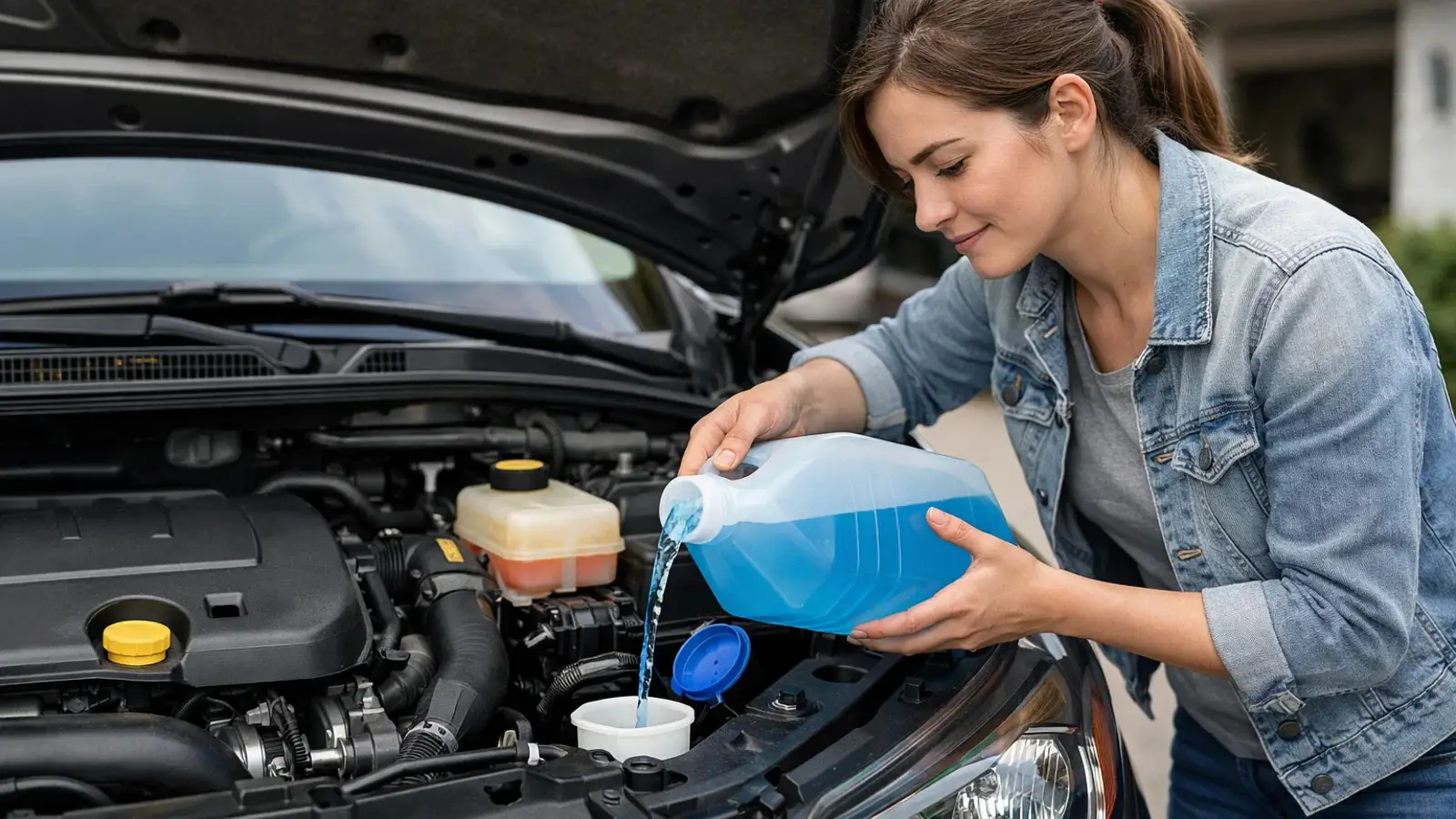
Discover the essential car fluids every driver should know, including engine oil, coolant, brake fluid and washer fluid, and learn how to check and refill them safely.
A car may seem like a complex mechanism, but in everyday use its condition largely depends on several quite understandable things — the fluids that ensure the operation of the engine, brakes, cooling system, and other components. For a beginner driver, these often become the first practical step toward understanding how a vehicle works. However, even at this stage an important detail appears: there is no universal list of “all fluids that exist in every car.”
Modern manufacturer manuals show that even models from the same brand may differ in their set of fluids. A typical gasoline or diesel vehicle always has engine oil, coolant, brake fluid, and windshield washer fluid. However, hybrids may include an additional cooling circuit for power electronics, while many newer cars no longer have power steering fluid at all because electric steering systems have replaced it. Therefore, the first rule for beginners is simple: before doing anything, open the owner’s manual for your specific vehicle.
Engine oil: the foundation of engine operation
Engine oil performs several tasks at once. It lubricates the moving parts of the engine, helps cool them, protects them from corrosion, and holds wear particles and combustion byproducts so they do not damage internal surfaces.
Checking the oil level is one of the simplest maintenance operations. Manufacturers recommend doing this either before starting the engine or a few minutes after shutting it off so the oil can drain back into the oil pan. The car should stand on a level surface.
The procedure usually looks like this: remove the dipstick, wipe it with a clean cloth, insert it again, and pull it out once more to see the actual level. It should be between the minimum and maximum marks.
If the level is low, oil is added through the oil filler cap in small portions. It is important not to exceed the upper mark — overfilling can be just as harmful to the engine as too little oil.
Coolant: protection against overheating and freezing
Coolant, or antifreeze, prevents the engine from overheating and at the same time protects the cooling system from corrosion and freezing.
The level is usually checked using the expansion tank. When the engine is cold, the fluid should be between the MIN and MAX marks (or L and F in some vehicles).
There is an important safety rule: the cooling system cap must not be opened when the engine is hot. The system is under pressure, and hot fluid may burst out.
It is also important to remember that coolant is not simply water and not pure antifreeze. It is a mixture designed to provide specific operating properties. If the liquid spills on parts or the body, it is recommended to rinse it off with water.
Brake fluid: an invisible element of safety
The braking system in most vehicles operates on a hydraulic principle. When the driver presses the pedal, the force is transmitted through brake fluid to the braking mechanisms at the wheels.
This fluid has an important property — it absorbs moisture from the air. Over time this can reduce its characteristics, which is why many manufacturers recommend replacing it about every two years.
The fluid level is checked using a transparent reservoir. It should be between the MIN and MAX marks. If the level drops noticeably, the reason may not only be a lack of fluid but also worn brake pads or a leak.
Manufacturers also warn that brake fluid must meet the specified standard — for example DOT 3 or DOT 4 — and should come from a sealed container.
Windshield washer fluid: simple but important
Windshield washer fluid is often perceived as a minor detail, but it is what ensures proper visibility in bad weather.
Different compositions are used for different seasons. Winter fluids are designed for low temperatures and do not freeze in the reservoir or the nozzles.
If the reservoir is empty, the washer lever should not be held for too long — the pump may overheat. And if the nozzles become clogged, they should not be cleaned with sharp objects because this can damage the mechanism.
Power steering fluid: not present in every vehicle
Many modern cars use electric power steering. In such systems hydraulic fluid is not used at all.
If the steering system is hydraulic, the fluid level is usually checked in a reservoir with MIN and MAX marks. Before checking, it is recommended to warm up the engine and turn the steering wheel from lock to lock several times.
If the level is below normal, the fluid is added in small portions.
Transmission fluids
The transmission is one of the most complex components of a vehicle, and the fluids used here may differ depending on the type of gearbox.
Automatic transmissions use one type of fluid, continuously variable transmissions another, and manual gearboxes a third. Manufacturers clearly state that transmission fluid must be selected strictly according to the owner’s manual.
There is no universal fluid suitable for all gearboxes.
Differential oil
In some vehicles, especially those with all-wheel drive or performance configurations, a separate oil is used for the differential.
Manufacturers warn that using an unsuitable oil may cause noise, vibration, or damage to the mechanism.
AdBlue and diesel emission control systems
Modern diesel vehicles often use a fluid called AdBlue. It is used in selective catalytic reduction systems to reduce harmful emissions.
The tank for this fluid must be refilled periodically. Depending on the vehicle and driving conditions, AdBlue consumption may represent several percent of fuel consumption.
Hybrids and electric vehicles
Sometimes it is said that electric vehicles have almost no fluids. In practice, this is not entirely true.
Even fully electric vehicles may have cooling systems for power electronics and batteries. Hybrid vehicles often include such cooling circuits as well.
How to prepare for checking fluids yourself
Before checking any fluid, manufacturers recommend following several simple rules.
The vehicle should stand on a level surface. It is advisable to prepare a clean funnel and cloth. Before opening reservoirs or caps, they should be cleaned from the outside so that dirt does not enter the system.
Most importantly, fluids should be added gradually while checking the level.
When it is better to stop
Many operations — checking oil level, topping up coolant, or refilling washer fluid — are accessible to almost any driver.
However, some vehicle systems require precise equipment and knowledge. When dealing with transmissions, differentials, or complex hybrid systems, it is better to follow manufacturer recommendations and visit a service center.
In the end, understanding automotive fluids is not so much about technical complexity as it is about attentiveness. Most procedures begin with the same step: opening the owner’s manual. That is where the exact answers can be found about what to fill, where to fill it, and in what quantity.
Ethan Rowden
2026, Mar 15 17:30