
Skoda Enyaq RS expedition in Kenya tests EV limits
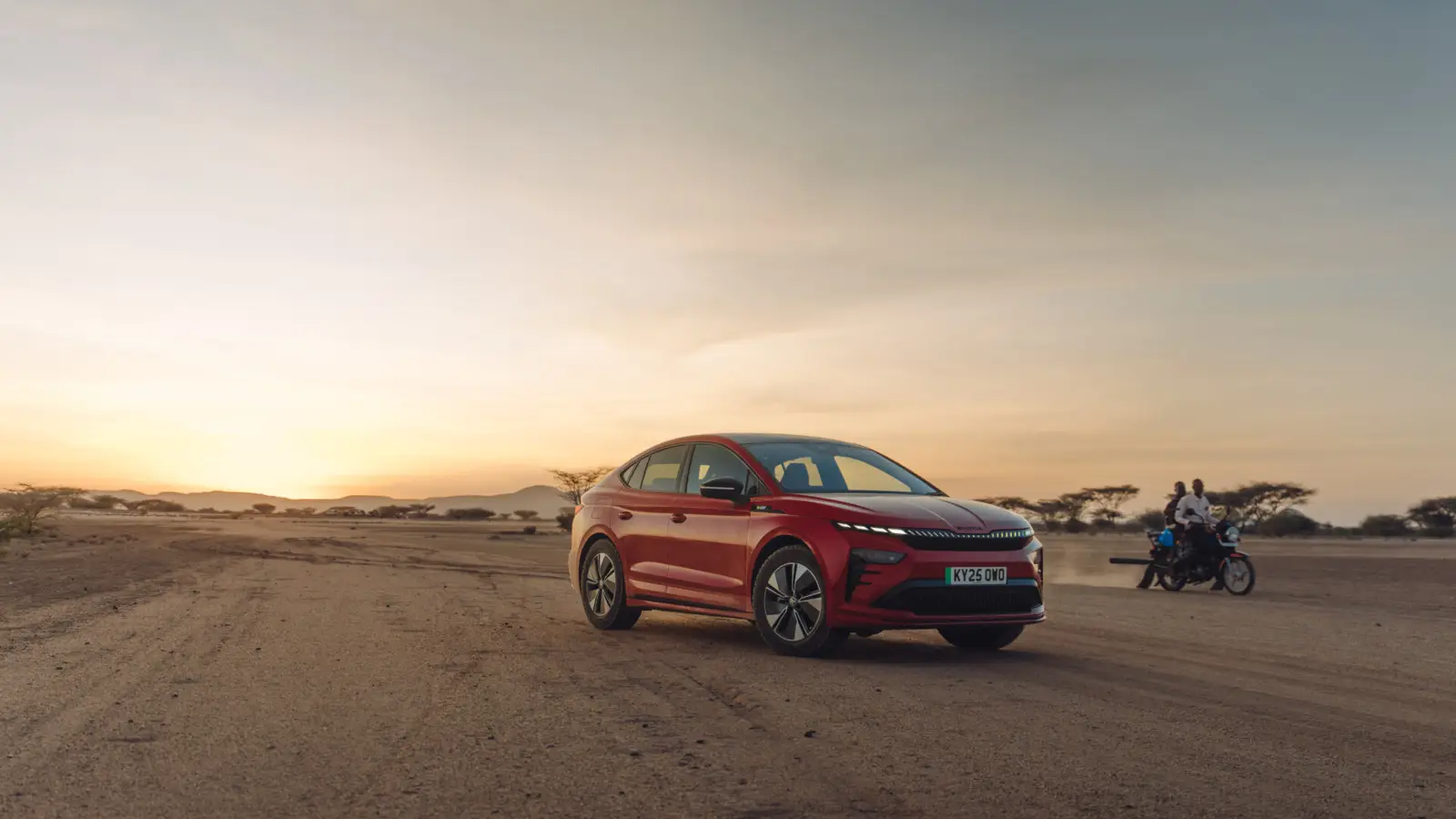
BBC Earth and Top Gear report on a Skoda Enyaq RS expedition across Kenya’s Turkana region, showing how an electric vehicle operates in remote conditions.
A standard-production electric car crossed more than 500 kilometres of remote northern Kenya, where temperatures approach 40°C and charging infrastructure is virtually absent. The Škoda Enyaq Coupé RS took part in an expedition organised by BBC Earth and BBC Top Gear, testing whether an electric vehicle can operate far beyond its usual environment — and it proved it can.
The route led through the Lake Turkana region, one of the most important areas for understanding human origins. Sites such as Koobi Fora have yielded hundreds of fossils, including remains of Homo habilis and Homo erectus, as well as footprints showing that different human species coexisted around 1.5 million years ago. The region continues to serve as an active research hub, supported by the Turkana Basin Institute, which provides facilities for scientists working in the area.
Against this backdrop, the journey carried symbolic weight. It connected a place deeply linked to human evolution with a technology shaping the future of mobility. In the absence of fast-charging infrastructure, the team relied on three-phase electricity commonly found in workshops and industrial sites. Using a portable adapter, the Enyaq charged at up to 11 kW, making continued travel possible.
The vehicle itself remained largely unchanged. Apart from off-road tyres, it retained its standard configuration, including dual electric motors for all-wheel drive, a dedicated Traction mode for challenging surfaces, and adaptive DCC suspension. With a system output of 250 kW and a usable battery capacity of around 79 kWh, the model is designed for long-distance travel, although actual performance depends on temperature and battery conditions.
The expedition highlights a practical insight: access to basic electricity can be more critical than dedicated charging infrastructure. Where a three-phase connection is available, electric vehicles can operate even in remote environments. The project ultimately reinforces a broader point — electric mobility is expanding beyond familiar use cases and is increasingly capable of functioning in conditions once considered unsuitable.
Mark Havelin
2026, Mar 18 20:14