
New Study Reexamines Adolf Rosenberger’s Role in Porsche History
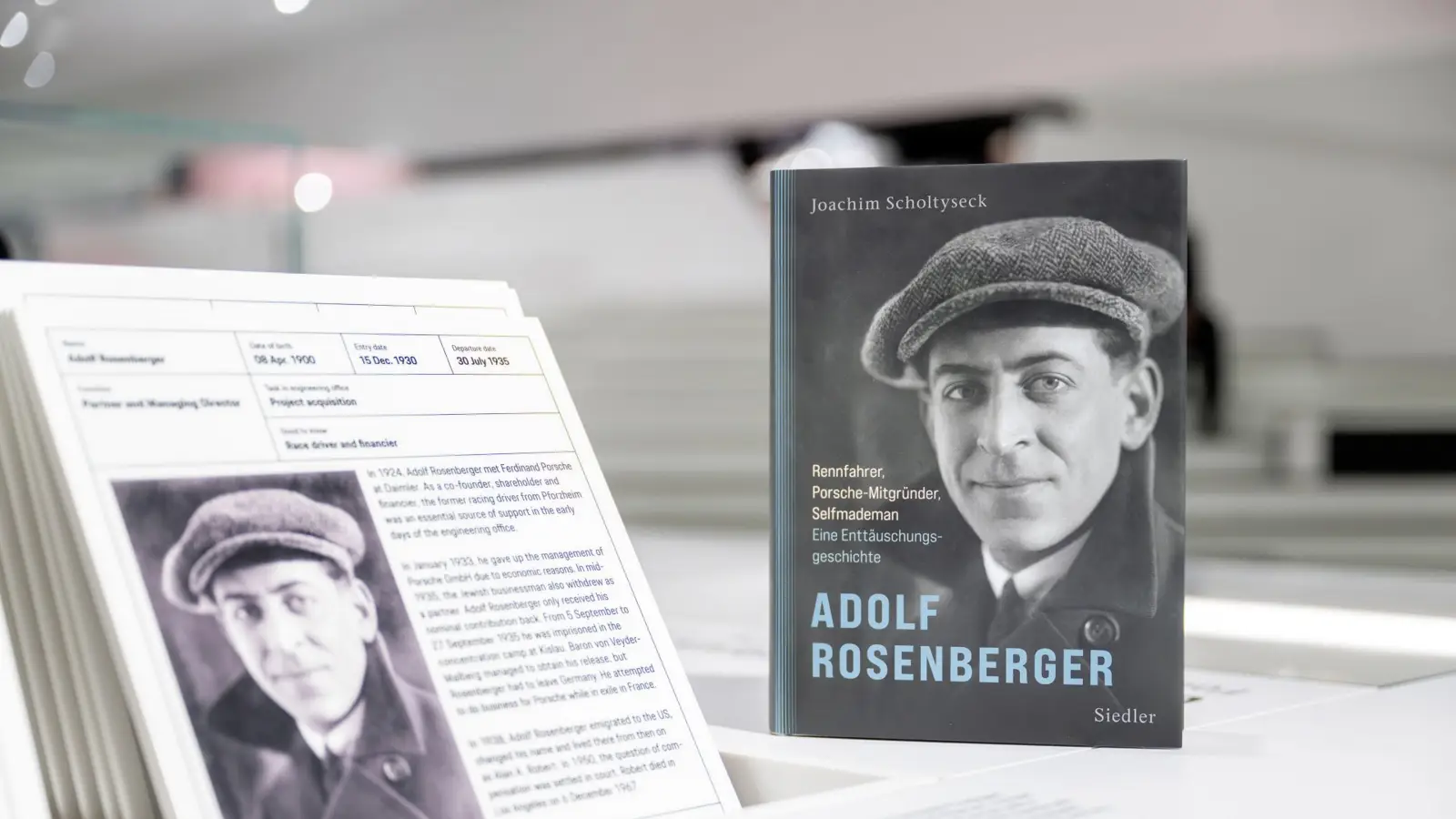
A new academic study by Porsche and historian Joachim Scholtyseck examines Adolf Rosenberger’s role, shedding light on early company history and overlooked contributions.
The history of Porsche has gained an important new dimension, as the life of one of its co-founders, Adolf Rosenberger, has been examined in depth for the first time. A new academic study by historian Joachim Scholtyseck of the University of Bonn brings back into focus a figure whose role in the company’s early years had long remained overlooked.
Rosenberger officially became one of the founders of Dr. Ing. h.c. F. Porsche GmbH on April 25, 1931, alongside Ferdinand Porsche and Anton Piëch. In the company’s formative phase, he was responsible for financial management and client relations, providing crucial start-up capital and business connections that helped stabilize the young engineering office.
Before that, Rosenberger had already established himself as a successful racing driver in the 1920s. German sources document numerous victories and podium finishes across European events, including hill climbs and circuit races. His sporting career, however, was marked by a serious accident at AVUS in 1926, after which he largely withdrew from competitive racing.
The turning point came in the mid-1930s. In 1933, Rosenberger stepped down from the company’s management, and by 1935, under the pressure of Nazi “Aryanization” policies, he was forced to transfer his shares in Porsche at nominal value. That same year, he was arrested and temporarily imprisoned in the Kislau concentration camp.
After his release, Rosenberger continued to work with Porsche from Paris, managing patents and licensing activities abroad. However, this cooperation ended in 1937. In 1938, he emigrated to the United States, where he attempted to rebuild his career under the name Alan A. Robert, achieving only limited success.
The post-war years proved equally challenging. Rosenberger sought compensation for the loss of his company shares, leading to a settlement in 1950. The financial outcome was modest compared to his claims, and further restitution efforts did not yield significantly better results.
The new study is based on a comprehensive evaluation of archival material, including previously unexplored documents from the Rosenberger family archive alongside records from Porsche’s corporate archive. This allowed for a detailed reconstruction of his life, from his upbringing in Pforzheim to his attempts to reconnect with Porsche after 1945.
The project was initiated through cooperation between Porsche and Adolf Rosenberger gGmbH, an organization founded by his descendants in 2019. A key principle of the research was its independence, with all parties agreeing in advance to accept the findings regardless of their conclusions.
The results were presented on March 19, 2026, at an academic symposium at Emory University in Atlanta, and the biography has now been published in both German and English. For Porsche, the project forms part of a broader effort to confront its past, including its more complex historical chapters.
The reintroduction of Rosenberger into Porsche’s narrative does more than fill a historical gap — it reshapes the understanding of the company’s origins, highlighting both his significant contribution and the circumstances under which his legacy was pushed aside.
Mark Havelin
2026, Mar 20 12:01