
Is a Safe Car Possible Without a B-Pillar?
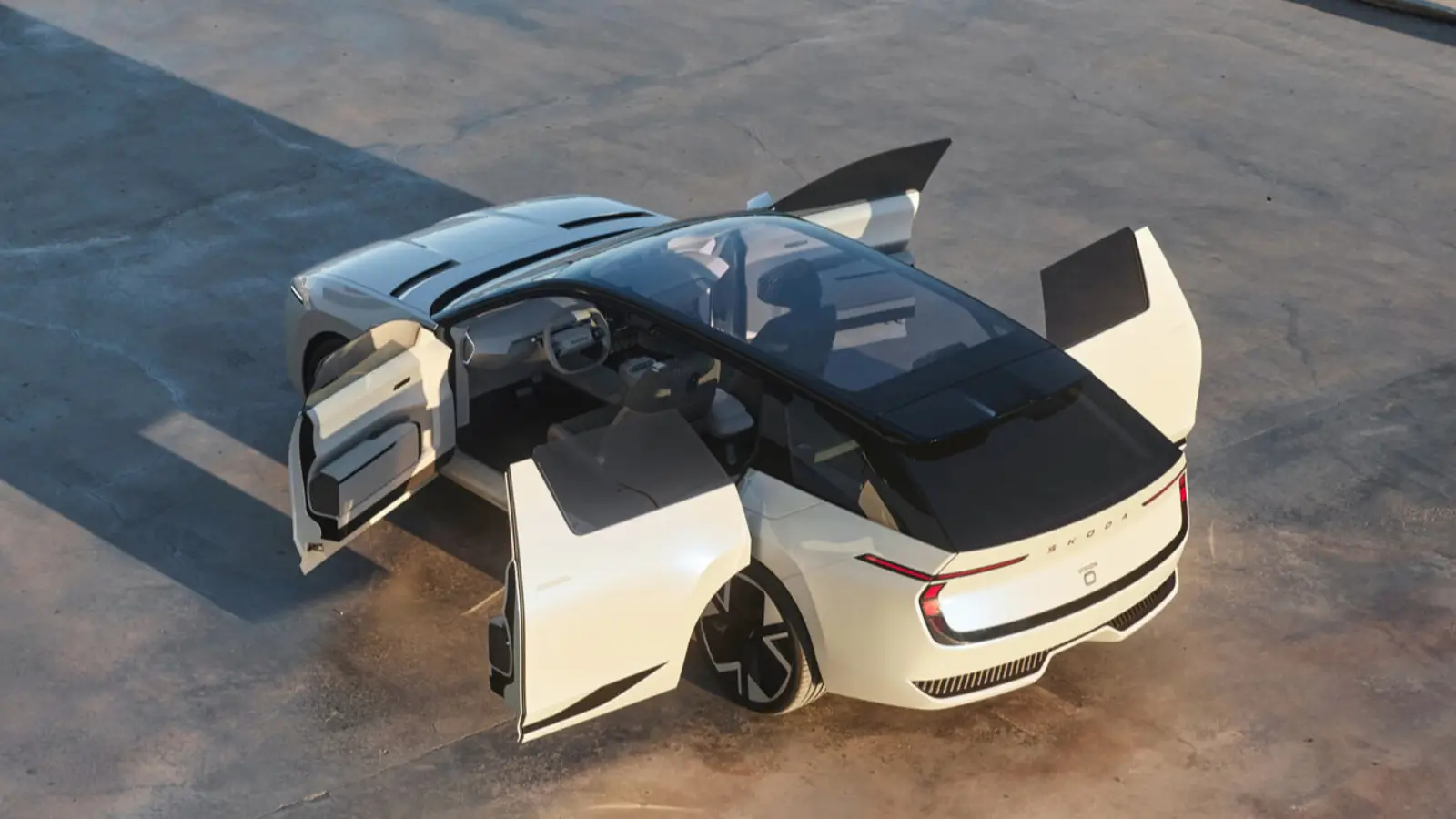
An in-depth look at whether cars can remain safe without a B-pillar, with examples including the Skoda Vision O concept presented by Skoda. Explore the engineering logic.
The B-pillar is one of those components most drivers never think about. It stands quietly between the front and rear doors, barely noticeable, yet it has shaped the safety logic of production cars for decades. At the same time, it is precisely this element that designers and engineers keep trying to rethink or remove altogether.
The reason is straightforward. A car without a B-pillar feels different: the side opening appears wider, the cabin more open, and entry and exit less constrained. Automotive history offers many such experiments, from classic pillarless hardtops of the last century to rare modern interpretations. Each of them, however, ultimately raises the same question — can this architecture be reconciled with safety requirements?
From an engineering standpoint, the B-pillar remains a key structural component. It links the roof and the sills, helps redistribute loads during a side impact, and limits how far the structure intrudes into the passenger compartment. In crash testing, movement and deformation in the B-pillar area are closely monitored because they are directly related to occupant injury risk.
This is especially critical in side-impact and pole-impact scenarios, among the most demanding tests for any body structure. Regulatory requirements in the United States and Europe, along with Euro NCAP and IIHS protocols, are designed to assess how well a vehicle preserves survival space in such collisions. Traditionally, the B-pillar plays a central role in this protection.
Removing it therefore means that its functions must be redistributed elsewhere. The history of pillarless hardtops illustrates this clearly. While they delivered an appealing open-side look, they were widely regarded as structurally less rigid. To compensate, manufacturers reinforced floors, sills, and roof structures, increasing mass and complexity. As unibody construction evolved and safety demands intensified, such designs gradually faded from the mainstream.
Yet the idea itself never disappeared. In modern automotive design, it returns in a more restrained and technological form. The Škoda Vision O Concept is a telling example. Rather than focusing on performance figures or radical technical claims, the electric concept emphasises clean surfaces, aerodynamic efficiency, and a strong sense of space. Notably, Škoda presented Vision O not only on a show stand but also on real roads, reinforcing its role as a credible vision rather than a purely theoretical exercise.
Vision O does not explicitly abandon the B-pillar, nor does it disclose structural details, but it reflects a broader trend: visually lighter side profiles, a greater feeling of openness, and a rethinking of traditional estate-car proportions while maintaining comfort and usability. It illustrates the same direction in which designers and engineers increasingly question how far conventional body structures can be reinterpreted.
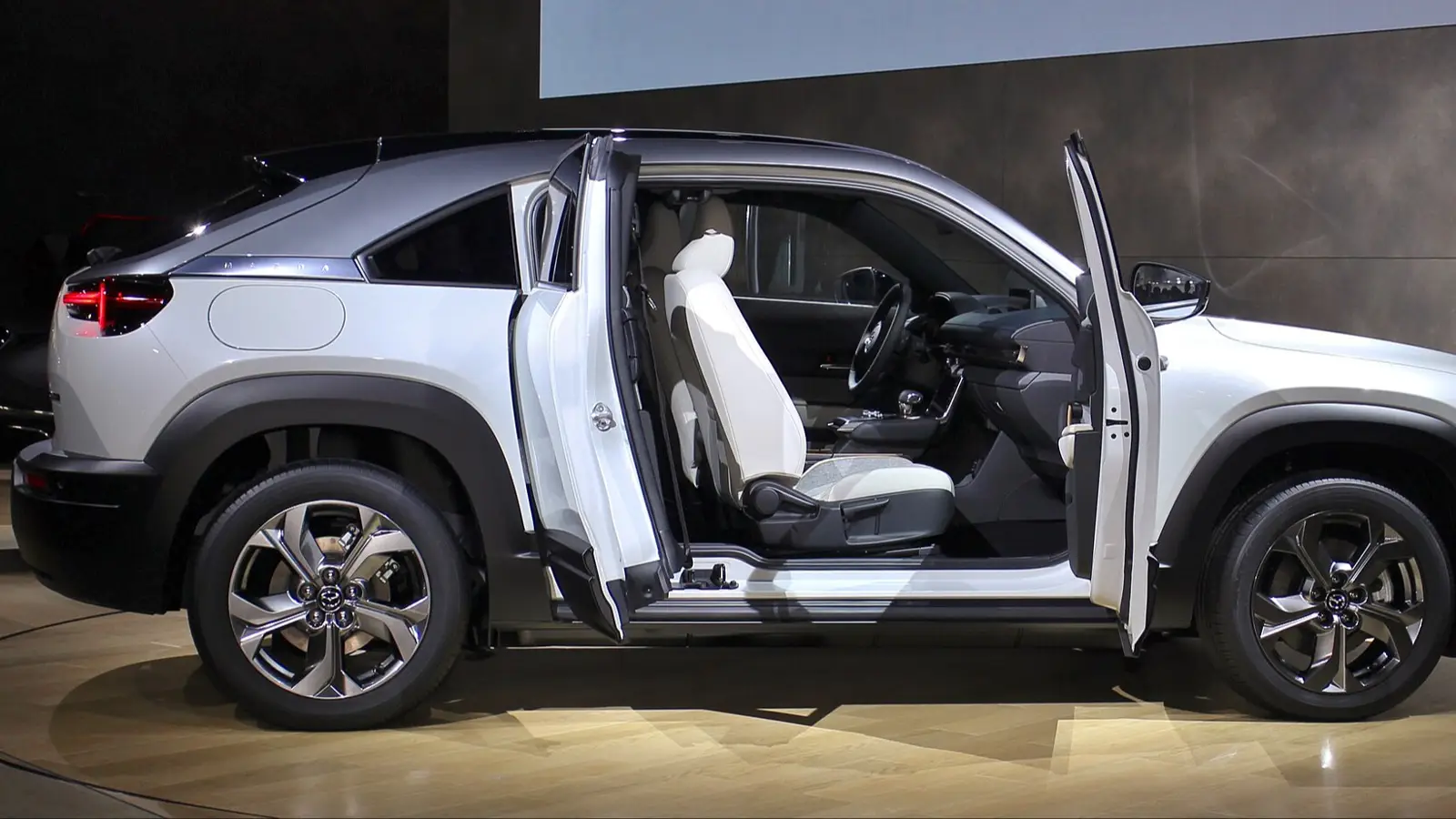

More radical answers already exist. In official technical publications, the Mazda MX-30 is described as having a body structure without a B-pillar, while acknowledging that such layouts typically raise concerns about stiffness and strength. These concerns were addressed through revised load paths and by using the battery pack as part of a rigid structural system.
A different approach can be seen in the BMW i3. Its passenger cell, made from carbon-fibre-reinforced plastic, is officially described as being built without B-pillars. In this case, safety is achieved not through conventional steel architecture, but through a stiff, closed CFRP safety cell that takes over the role of the structural backbone.


Together, these examples point to a clear conclusion: a safe car without a B-pillar is possible, but only with a comprehensive redesign of the vehicle’s structure. Reinforced doors, redesigned sills and roof rails, alternative load paths, and high manufacturing precision become essential. Seat-belt integration adds further complexity, as anchorage requirements are defined by separate regulations without prescribing a single structural solution.
Practical considerations also matter. Pillarless bodies traditionally demand higher standards in sealing, noise insulation, and door and glass alignment. This helps explain why such architectures tend to remain niche solutions or appear in concept cars, where boundaries can be explored without the constraints of mass production.
In the end, the question “is it possible to build a safe car without a B-pillar?” has a clear answer: yes, it is. Real vehicles and official engineering documents confirm this. At the same time, they also explain why the B-pillar remains the norm. It concentrates multiple structural and safety functions, and removing it inevitably leads to a chain of complex compromises.
Ethan Rowden
2026, Jan 07 21:38