
Mercedes presents electric GLC and GLB through new campaigns
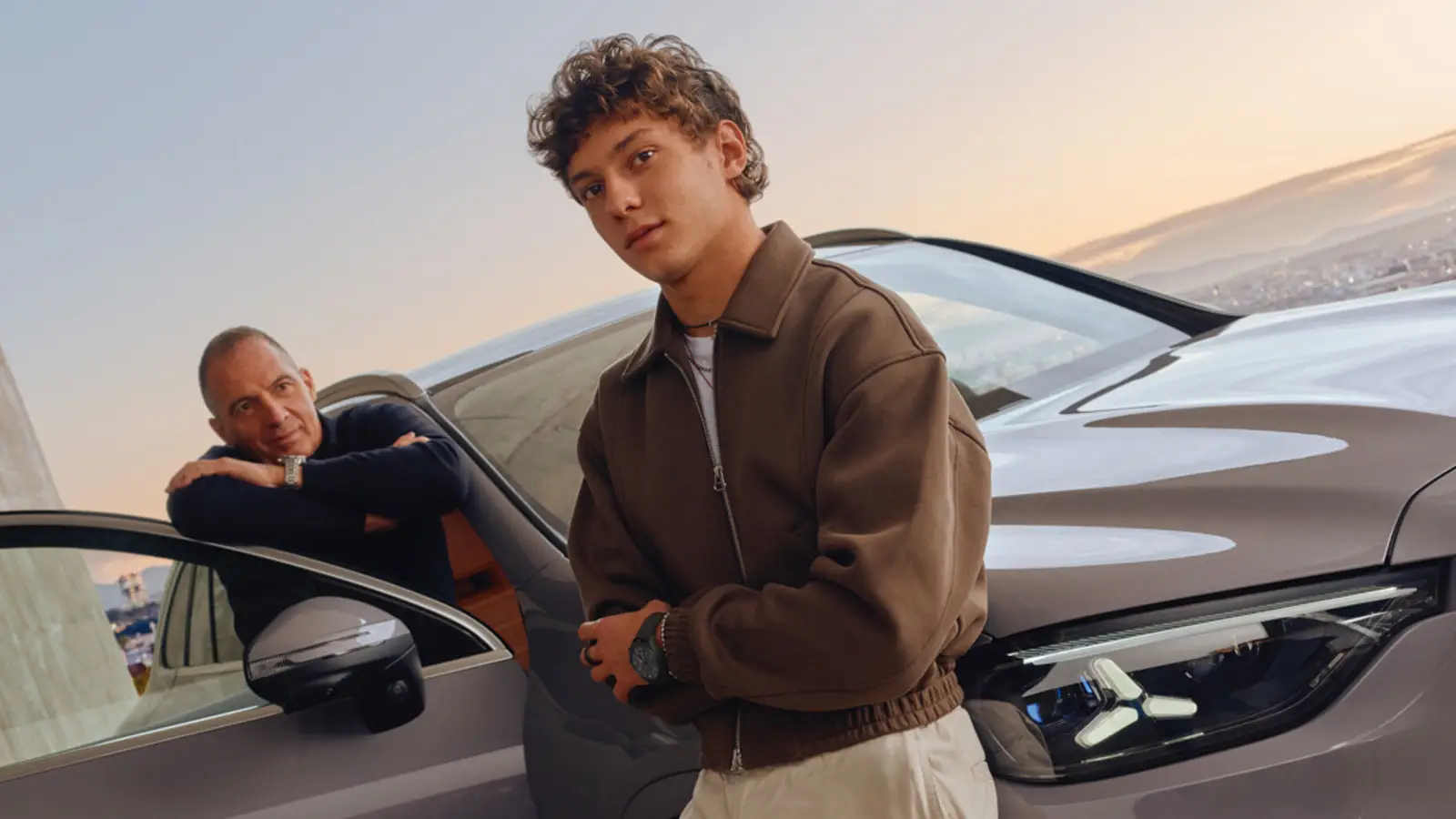
Mercedes-Benz presents new campaigns for electric GLC and GLB, focusing on real-life stories, comfort, and usability. Explore how the models are positioned.
Mercedes-Benz has launched two global campaigns for its new electric SUVs—and chose to tell the story through people rather than specifications. The focus is not on technology alone, but on reinforcing the idea of “home” as a defining experience inside its vehicles.
In the campaign for the electric GLC, Mercedes-AMG PETRONAS Formula 1 driver Kimi Antonelli appears alongside his father. What begins as a tense moment gradually shifts into calm as the car itself takes over the scene—through smooth driving, low noise levels and an interface that requires minimal effort. Instead of listing features, the film shows them in use: the panoramic roof, driver assistance systems, massage seats and the MBUX Virtual Assistant all emerge naturally within a single narrative of relaxation on the move.
This approach gains weight when placed against the product itself. The GLC is not just another model—it is Mercedes-Benz’s best-selling SUV and one of the brand’s core vehicles. In 2024, it became the top-selling series globally, and it is now transitioning into a fully electric form. The company states that the new GLC with EQ technology is designed to set benchmarks in range, efficiency and charging speed, while maintaining the comfort and character associated with the model.
The second campaign focuses on the electric GLB and shifts the perspective to family life. A short story about children returning from a fair with oversized plush toys becomes a way to demonstrate how the vehicle adapts to everyday demands. Here, practicality takes the lead: a maneuvering assistant, flexible interior layout and seating for up to seven passengers are presented as tools that simplify real-life situations.
These features position the GLB in a distinctive way within its segment. In the compact SUV class, a seven-seat configuration remains uncommon, and the electric version adds further capabilities: an 800-volt fast-charging architecture, a battery of around 85 kWh and a driving range that can exceed 600 km (WLTP) depending on the version. At the same time, the model retains versatility through elements such as a front trunk and adaptable seating arrangements.
Both campaigns follow a shared principle: Mercedes deliberately shifts away from highlighting specifications and instead builds narratives around everyday experiences. This aligns with a broader transformation of the brand. New models are developed not only as electric vehicles but also as software-defined systems, powered by MB.OS and an evolving MBUX ecosystem—from voice assistants to large-scale display concepts like Hyperscreen and Superscreen.
This communication strategy also reflects the company’s wider electrification roadmap. Mercedes aims to offer an electric option in every model line, while new architectures introduced from the mid-decade onward are designed as electric-first. In this context, the electric GLC and GLB are not isolated launches but part of a systematic shift.
The campaigns themselves began rolling out globally in mid-March across video platforms, social media, television and print. Creative development was led by team x, a dedicated agency for Mercedes-Benz, with direction by Caroline Koning.
Together, these elements form a consistent narrative: as the brand moves deeper into electrification, it is also redefining how it communicates value. Electric vehicles are presented not only as technological products, but as spaces of everyday experience—captured in the phrase “Welcome home,” which here functions less as a slogan and more as a lived scenario.
Mark Havelin
2026, Mar 20 21:46